Table of Contents
configure grid edit logging
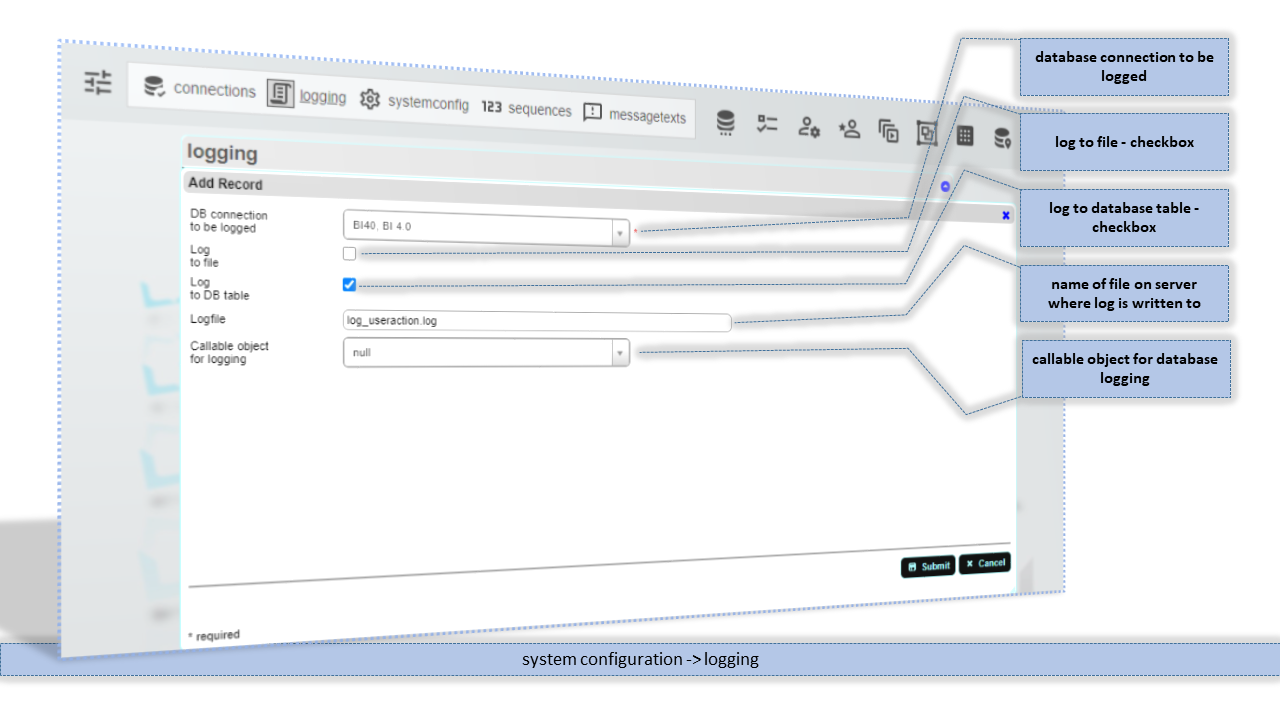
With this feature you can configure logging for an existing database connection. Grid edit logging means that all SQL commands that changes data are logged.
- add/edit a record → enter valid values for fields listed below
DB connection to be logged
Database connection for which updates in tables, triggered by niota web editor, will be logged. Select a database connection from the drop down list.
Log to file
Switch checkbox on if you want the logs to be written into the file entered in Logfile.
Log to DB table
Switch checkbox on if you want the logs to be written into a database table. The structure of the database table must be like user action table.
Logfile
Filename and file extensions of the file where the logs are written in case Log to file is on. The logfile is located on the niota server in directory app\logs.
Callable object for logging
Choose a valid callable object (stored procedure) that handles the logging finally. This can be a delivered system log procedure or your own procedure in case you do not want to log to N-MDDB.
Logging of callable objects
When logging a callable object call the logging connection is set according to the followings:
- When a callable object is bound to a catalog instance and called from the grid-custom-menu then the log-connection of the catalog instance is used.
- When a callable object is called from the transaction menu then the log-connection of the callable object connection is used.
- If a callable object content is placed in a file (web service or batch sql call) then only the file name is logged in the case of a successful call.
- If a callable object content is placed in a file (web service or batch sql call) and the call is unsuccessful then the final command / web service call is logged in the error log files.
System log files
There are log files which are not configurable. Those are created automatically during the running of the program.
- debug.log ⇒ Stores debug info. Can be activated by using debug feature.
- error.log ⇒ Stores error messages generated during the running of the server side conde - PHP error messages.
- error_sql.log ⇒ Stores sql statements which could not be executed. Also stores the database server response.
- error_ws.log ⇒ Stores xml contents which could not be executed. Also stores the server response.